Through my Joyful Mortals project, I help people make a joyful, loving, and deep life by connecting everyone with mortality. In my Joyful Mortals lectures and workshops, the participants talk freely about death, learn, and have a fantastic time.
If you wonder, “Why is talking about death important?”, instead of quoting a bunch of literature, I will share my story:
In Fall 2017, I flew with my four-year-old son from Seoul to Vancouver, for my PhD study. I was raising him by myself. In early 2018, I met someone who shook me to the core and revealed what the lack of education and conversation on death could do to a person. The person asked me, “Do you know the feeling that you really miss yourself?” Having survived a year and a half with his baby daughter since his wife’s sudden death, this educated, successful man missed the self he used to be and felt that he had lost a sense of identity. He was suffering from PTSD. His stories made me realize what could happen to me or to my son if either of us died suddenly or was diagnosed with a terminal illness. Although death really scared me (I had sometimes lost sleep over the fear of death), I felt compelled to learn about it. I knew, at least, that it was the unknown that aroused fear. So I started to dig into books on death and search for community meetings and workshops on death. I volunteered to work with dying people.
After a few years studying death, I no longer lost sleep over it, nor was I afraid of it. Readings on the topic and interactions with people in the deathcare industry were life-affirming. The awareness that I am a mortal being helped me focus my life and more fully enjoy it.
I try my best to respond to my young son’s curiosity about dying and death, and he knows what to do if I die or fall unconscious. Most importantly, I have come to feel deeply connected with others. As Comedian Ellen DeGeneres captured beautifully, “Everyone has a fear. … It’s not until you’ve faced that fear head-on that you realize your power. And that’s when you grow. … We are all the same. … We are all relatable” (quoted from Relatable on Netflix).
So, as someone who experienced first-hand the tremendous benefits of learning about the finitude of life, I am totally motivated to help everyone ponder mortality.
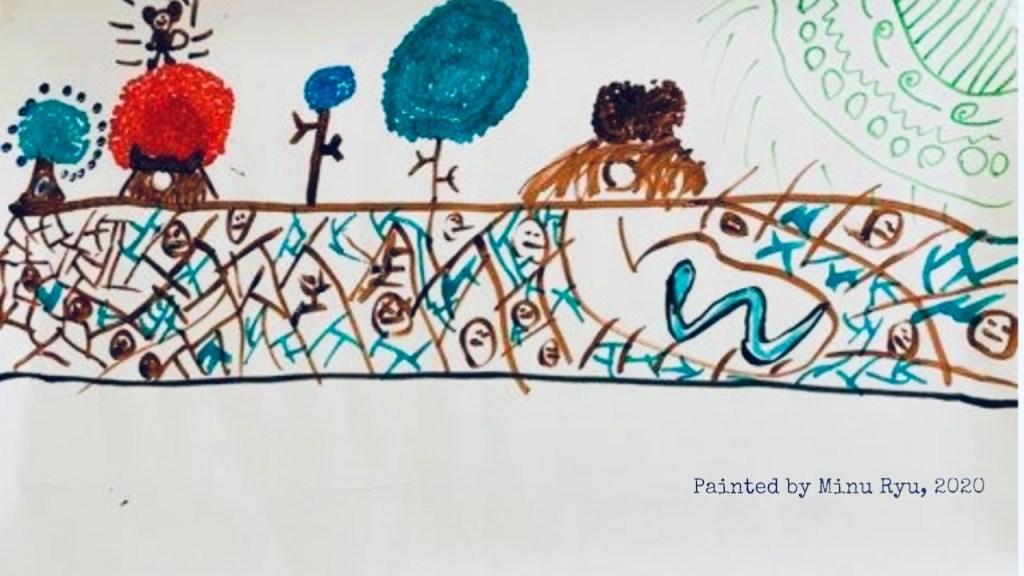
When my son showed this drawing to me, I pointed at the circles with faces underground, and asked him what they were. He answered, “They are dead people.” I asked, “Dead people? Why did you draw dead people?” With a nonchalant shrug, he replied, “Why not?”
He was right. Why don’t we see deaths beneath the ground? If we adults were to see them, the world would be a lot different. For one, we will understand that deaths nourish lives and will start to care for all creatures, humans and non-humans.
 Hyunok Ryu